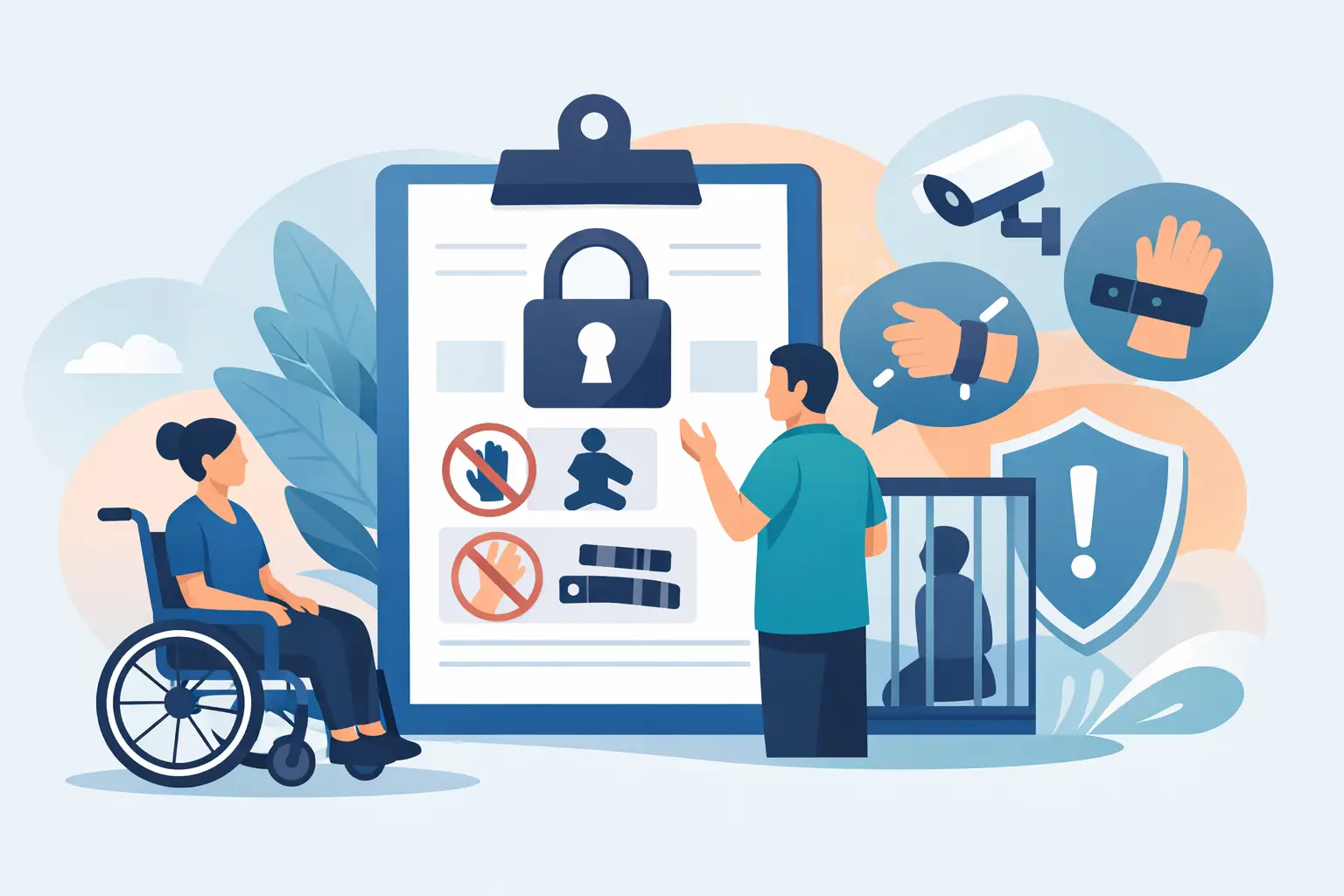
A locked cupboard, a blocked doorway, medication used to manage behaviour, or holding someone to stop them moving may sometimes be described as safety measures. Under restrictive practice rules, however, the key question is whether the action limits a person’s rights or freedom of movement. If it does, it must be carefully assessed, justified and managed - not treated as a routine part of care.
For NDIS participants, families, support workers and providers, understanding these rules helps protect both safety and dignity. It also helps everyone focus on the outcome that matters most: reducing the need for restrictive practices through respectful, proactive support.
What is a restrictive practice?
A restrictive practice is any intervention or practice that restricts the rights or freedom of movement of a person with disability. It may be used in response to behaviours that place the person or others at risk of harm, but only in limited circumstances.
The National Disability Insurance Scheme (NDIS) framework recognises five regulated restrictive practices. Seclusion involves confining a person alone in a space they cannot leave. Chemical restraint means using medication for the primary purpose of influencing behaviour, rather than treating a diagnosed medical condition. Mechanical restraint uses a device to restrict movement, while physical restraint involves physical force to stop a person moving freely.
Environmental restraint is often less obvious. It can include restricting access to areas, objects or activities, such as locking food away, preventing a person from leaving their home, or using barriers that limit movement. Whether something is a restrictive practice depends on its purpose, how it is used and its impact on the individual.
This does not mean every safety support is automatically restrictive. For example, a locked medication cabinet may be an ordinary household safety measure in some settings. It may become an environmental restraint where it specifically prevents a person from accessing something they would otherwise be entitled to access. Context matters.
Why restrictive practice rules exist
People with disability have the same right as anyone else to make choices, take part in everyday life and be treated with respect. Restrictive practices can cause distress, reduce autonomy and, when used poorly, create further harm. They can also mask unmet needs such as pain, trauma, communication difficulties, sensory overload, anxiety or an unsuitable environment.
The rules are designed to prevent restrictive practices from becoming a default response to complex behaviour. They require providers to understand what is happening before deciding how to respond. A behaviour is not simply a problem to stop. It is often communication about an unmet need, a difficult situation or a lack of appropriate support.
A person who throws objects in a noisy setting, for instance, may be overwhelmed by sound or unable to communicate that they need a break. A person repeatedly trying to leave may be seeking familiarity, connection, activity or control over their day. Restricting their movement without exploring these factors is unlikely to create a lasting solution.
When can a restrictive practice be used?
Under the NDIS approach, a regulated restrictive practice must only be used as a last resort. It should be the least restrictive option available, proportionate to the immediate risk, and used for the shortest possible time.
It must also form part of a Positive Behaviour Support plan developed by a suitably qualified behaviour support practitioner, unless there is an emergency. An emergency response may be needed to prevent immediate serious harm, but an emergency does not justify ongoing or repeated restrictive practice without assessment, planning and review.
A clear plan identifies the behaviour of concern, the risks involved, likely triggers and the supports that can reduce those risks. It should set out prevention strategies, skill-building goals, appropriate staff responses and any restrictive practice that has been assessed as necessary. Most importantly, it should include a strategy to reduce and eliminate the restrictive practice over time wherever possible.
Consent is important, but consent alone does not make a restrictive practice lawful or appropriate. State and territory authorisation requirements may apply, and these differ across Australia. In Queensland, providers must meet relevant state requirements as well as NDIS Commission obligations. Families, guardians and providers should not assume that agreement between those involved is sufficient without checking the applicable process.
Who has responsibilities under the rules?
Restrictive practices involve shared responsibilities, but each person’s role is different. The NDIS participant should be included in decisions in a way that suits their communication needs and capacity. Their preferences, goals, culture, relationships and lived experience must be taken seriously.
Families, carers and support coordinators can provide valuable information about what helps, what causes distress and what a good day looks like for the participant. They can also ask questions when a restriction appears to be used regularly or without a clear plan.
Behaviour support practitioners assess the situation and develop comprehensive behaviour support plans. They work with the person and their support network to identify practical alternatives, such as communication supports, predictable routines, sensory adjustments, skill development or changes to the physical environment.
NDIS providers and workers must follow the approved plan, receive appropriate training and keep accurate records. They also have reporting obligations when regulated restrictive practices are used. Documentation should show what occurred, why it was necessary, how long it was used, its impact, and what can be changed to reduce future use.
What Positive Behaviour Support looks like in practice
Positive Behaviour Support is not about controlling a person’s behaviour. It is a person-centred approach that seeks to improve quality of life while reducing behaviours that may place someone at risk.
For a child, this may mean teaching a simple way to ask for help before frustration escalates. For an adult, it may involve creating a routine that includes meaningful activities, clearer choices and planned time away from overwhelming environments. For someone who has difficulty with unexpected changes, visual schedules and advance notice may reduce anxiety more effectively than any restrictive response.
The best plans are practical enough to use in real life. They provide clear guidance for families and staff without reducing the person to a list of incidents or risks. They also recognise that a strategy that works in one environment may not work in another. Home, school, community programs and supported accommodation each bring different demands and supports.
At In Mind Therapy, Positive Behaviour Support is approached alongside the person’s broader wellbeing, communication needs and daily life. This helps ensure that planning is not limited to managing incidents, but supports meaningful participation and safer, more confident relationships.
Questions to ask if you are concerned
If a restrictive practice is being proposed or used, it is reasonable to ask direct questions. What risk is the practice intended to address? What other strategies have been tried? Is there a current behaviour support plan? Has the practice been authorised where required? How is it being monitored, reported and reviewed?
You can also ask what the plan is to reduce the practice. A restrictive practice should never be seen as a permanent answer simply because it is familiar or convenient. If it is used repeatedly, the support team should review the underlying causes and whether the current supports are genuinely meeting the person’s needs.
It can be helpful to request that information is explained in plain language. Participants and families should understand what is proposed, when it may happen, who can use it and what rights they have to raise concerns. Good support is transparent, not secretive.
A safer path forward
Restrictive practices may arise in situations involving genuine and immediate risk, and those situations can be stressful for everyone involved. But safety and dignity are not competing goals. Careful assessment, skilled Positive Behaviour Support and regular review can reduce risk while preserving a person’s rights, voice and everyday choices.
When support starts with curiosity about what a person is communicating, it creates more room for practical solutions - and less reliance on restriction.