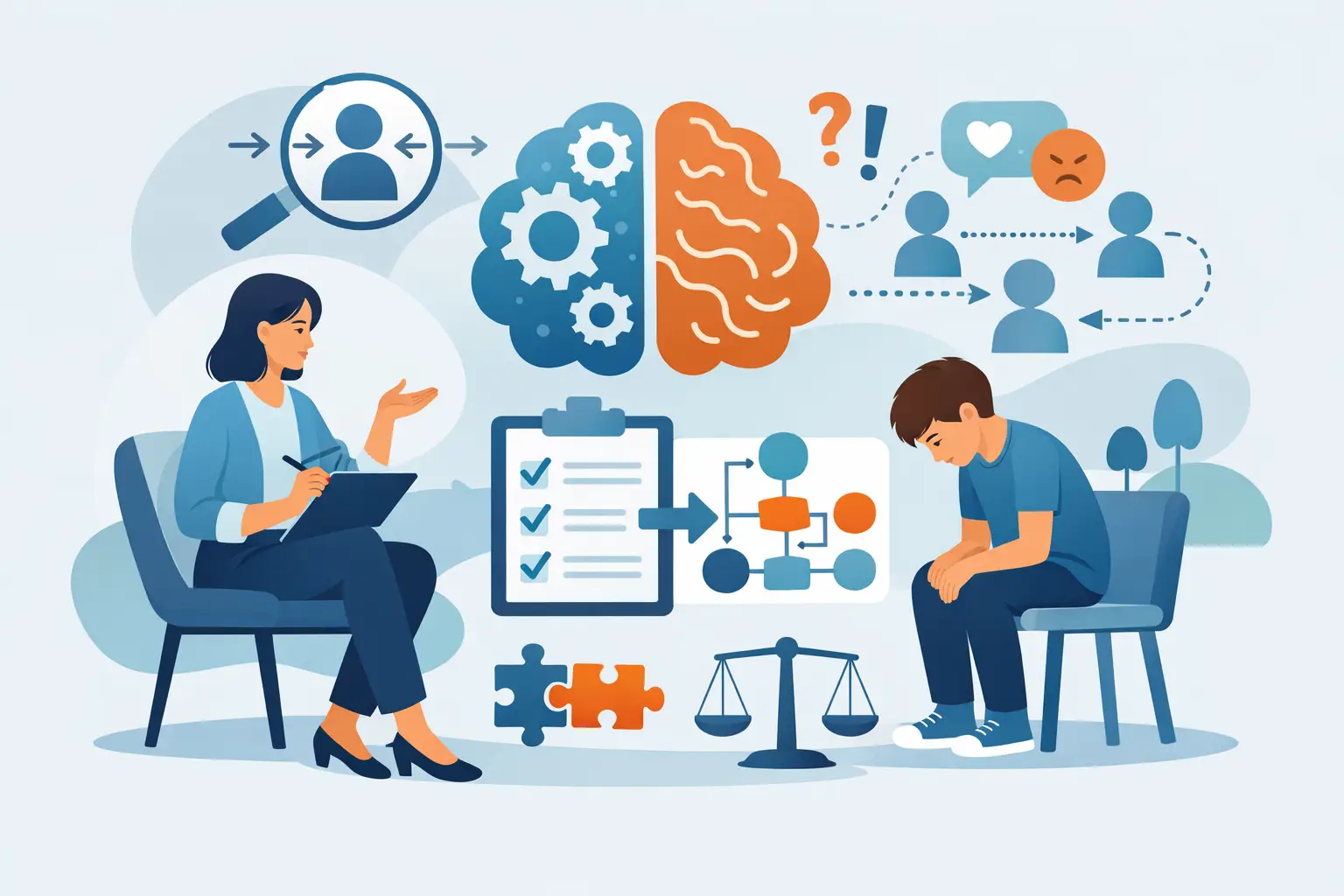
When behaviour is creating stress at home, school, work or in the community, the question is rarely just how to make it stop. Functional assessments look at what may be happening around and before a behaviour, what the person may be communicating, and what support could make everyday life safer and more manageable.
For NDIS participants, families and support teams, this process can replace assumptions with useful information. It provides a clear foundation for Positive Behaviour Support that respects the person, their needs and their right to be involved in decisions about their care.
What is a functional assessment?
A functional assessment is a structured process used to understand the purpose, or function, of a behaviour of concern. Behaviour can serve many purposes. It may be a way to communicate discomfort, avoid a difficult task, gain access to something important, seek connection, respond to sensory needs, or manage feelings that are difficult to express in another way.
The assessment does not label a person as difficult or define them by a single behaviour. Instead, it considers the whole context. This can include health, communication, sensory preferences, relationships, routines, environments, past experiences and the demands being placed on the person.
A functional assessment is often part of a broader Positive Behaviour Support process. Under the NDIS, it may inform a behaviour support plan, particularly where behaviours are affecting safety, participation or quality of life. The findings help identify practical, proactive strategies that can be used consistently across the person’s everyday settings.
Why understanding the function matters
A response that focuses only on stopping a behaviour may provide short-term relief without addressing the reason it is occurring. For example, if a child becomes distressed during a noisy transition, a consequence-based response is unlikely to help if the core issue is sensory overload, uncertainty or difficulty communicating their needs.
When support teams understand the function, they can make meaningful changes. This may involve adjusting routines, reducing unnecessary demands, offering visual supports, building communication skills, creating calm spaces or teaching safer ways to ask for a break. The best approach depends on the person and their circumstances.
This understanding is also important for carers and support workers. It can reduce blame and uncertainty, particularly when behaviour feels unpredictable or emotionally exhausting. A clear plan gives everyone a shared way to respond, while allowing room to adapt when the person’s needs change.
Behaviour is communication, but context is essential
The phrase “behaviour is communication” is useful, but it should not oversimplify what a person is experiencing. Behaviour may be influenced by pain, fatigue, anxiety, trauma, medication changes, communication barriers, hunger, grief or a change in living arrangements. It can also be shaped by what happens after the behaviour, even when nobody intends to reinforce it.
A quality assessment considers these possibilities carefully. It does not assume that every behaviour has one simple cause. Some behaviours have more than one function, and the function may differ between settings or times of day.
What happens during functional assessments?
The process should be collaborative and respectful. A practitioner gathers information from the person, where possible, as well as family members, carers, educators, support workers and other relevant professionals. The aim is to understand daily life from more than one perspective.
Information may be collected through conversations, record reviews and observations in relevant settings. A practitioner may look for patterns in what happens before a behaviour, the behaviour itself and what occurs afterwards. This is sometimes called an ABC approach: antecedent, behaviour and consequence. It is not about finding fault. It is a practical way to identify patterns that may otherwise be missed during busy or stressful days.
The assessment may also explore communication abilities, sensory needs, health factors, sleep, meaningful activities, relationships and environmental barriers. For an NDIS participant, it is important that the process connects with their goals, strengths and support arrangements rather than focusing solely on risk.
Where there is immediate risk of harm, safety planning may need to happen alongside the assessment. In these situations, the priority is supporting safety while still working towards longer-term, positive changes.
From assessment to practical support
The value of an assessment lies in what happens next. The findings should be translated into clear strategies that the person and their support network can realistically use.
A Positive Behaviour Support plan may include changes that reduce triggers, build on existing strengths and increase choice and predictability. It can also describe skills the person could be supported to develop, such as using a visual card to request space, choosing between two activities, recognising early signs of distress or practising calming strategies that suit them.
Support strategies should be specific enough to guide everyday responses. Rather than advising staff to “stay calm”, a useful plan explains what calm support looks like in practice: reduce language, offer time, move away from noise, provide a familiar choice, or contact an agreed person if risk increases.
Consistency matters, but plans should not be rigid. A strategy that works at home may need adjustment at school, in supported accommodation or during community access. Regular review helps ensure the plan remains relevant as the person gains skills, circumstances change or new concerns arise.
The role of families, carers and support workers
Families and carers often hold the most detailed knowledge of a person’s routines, preferences, warning signs and successful supports. Their input is central to a meaningful assessment. At the same time, they should not be expected to manage complex behaviours without appropriate guidance, respite or professional support.
Support workers and educators also play an important role because they may observe patterns in settings that families do not see. When everyone works from the same plan, the person is less likely to receive mixed messages or responses that unintentionally increase distress.
Collaboration should include the person wherever possible. This may involve accessible language, visual tools, supported decision-making, interpreters or input from an advocate. Being heard is not an optional part of quality support. It helps ensure strategies are respectful, relevant and more likely to work.
When a functional assessment may be helpful
A functional assessment can be useful when behaviours are becoming more frequent, more intense or harder to manage. It may also be appropriate when a person is withdrawing from activities, struggling with changes, experiencing repeated conflict with others, or facing barriers to participation at home, school, work or in the community.
It is not only for crisis situations. Early assessment can help identify supports before stress escalates. For some people, a small change to a routine, environment or communication approach can make a significant difference.
However, behaviour support is not a substitute for medical or mental health assessment where these are needed. Sudden changes in behaviour, particularly alongside pain, confusion, altered sleep, appetite changes or significant mood changes, may require review by a GP or relevant health professional. Good care considers both behavioural and health-related explanations.
Choosing a respectful approach
A functional assessment should uphold dignity, privacy and the person’s rights. It should focus on improving quality of life, not simply making behaviour more convenient for others. Restrictive practices are never a first response and, where they are used, they must be carefully regulated, documented and reduced wherever possible under the relevant NDIS requirements.
At In Mind Therapy, Positive Behaviour Support is approached as practical, person-centred work. The goal is to help participants, families and support teams understand what is happening, build skills and create conditions where the person can feel safer, more capable and more included.
The most helpful next step is often a conversation about what is happening now, what has already been tried and what a better day would look like for the person and those supporting them.